Peptide Purity Overview 98%, 99% & Research-grade Discussed Prg
Throughout solid-phase synthesis, each amino acid combining step has a yield of about 99-- 99.8%. When a combining fails, the expanding chain is covered to stop further elongation of the inaccurate series. The result is a peptide that's shorter than planned-- missing several amino acids.Peak Research laboratory is a specialized distributor of high-purity chemical reagents and peptides. All items detailed are strictly for in-vitro research laboratory r & d make use of just. Discover flagship study peptides with batch-specific COA paperwork and HPLC/MS verification. Products are for in-vitro laboratory research usage just and are except human consumption.
What Does Hplc-tested Mean?
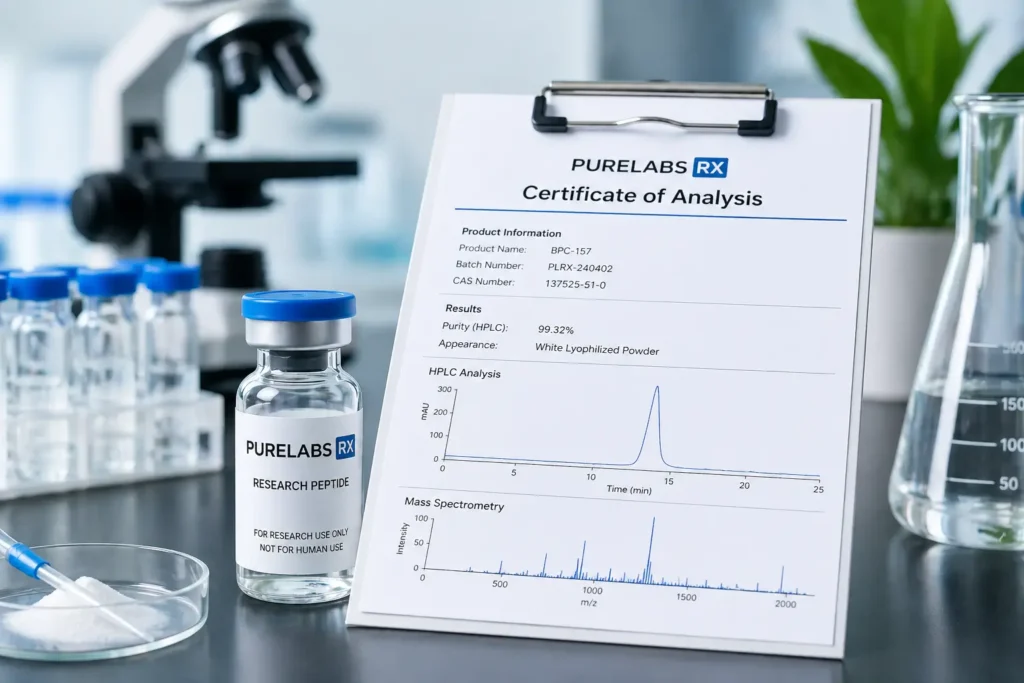
Other strategies like electrophoresis, capillary electrophoresis (CE), and nuclear magnetic resonance (NMR) can also be used to examine peptide framework, charge, and pureness, making certain thorough characterization. In COA evaluation, it normally consists of HPLC purity testing, mass spectrometry identity verification, and batch-specific documentation revealing the examined whole lot, approach, results, and day. For peptide pureness screening, reverse-phase HPLC is the standard theoretical model. The chromatographic pureness is after that determined by contrasting the area under the primary top with the total location under all incorporated tops.
Very few commercial research peptide suppliers supply MS/MS information on regular COAs-- it is commonly booked for pharmaceutical-grade products and progressed study setups. Nonetheless, some costs distributors do give it on request for essential sets. If series confirmation is important for your research study, this is the analysis to request. It divides the components of a sample based upon their differential affinity for a stationary phase (column https://pharmagrade.store/ packaging product) and a mobile phase (solvent system moving with the column). Peptides, with lengthy molecular sequences and varied conformations, existing difficulties for structure verification and content resolution. BOC Sciences leverages high-resolution mass spectrometry, LC-MS/MS, and NMR to properly analyze molecular frameworks and supply extremely sensitive quantitative support.Associated Solutions
Peptide screening is the set of logical checks utilized to review a peptide example before it is utilized in a study process. In functional COA review, the term generally refers to pureness screening, identification screening, and documents testimonial. Pureness screening asks just how much of the detected example is the major peptide versus related contaminations. Identification screening asks whether the measured mass or sequence-related proof matches the intended peptide. Documentation review asks whether the report is batch-specific, deducible, and described enough to be investigated. Peptide testing is the logical procedure used to confirm that a study peptide is both pure and appropriately identified.By insisting on peptides that come with confirmation of pureness and identification, researchers can significantly reduce the threat of experimental artefacts. On the other hand, using peptides that have actually passed third-party lab recognition helps make sure that the observed experimental effects are really as a result of the designated peptide and not because of pollutants or mistakes. When you see peptides marketed as "research-grade," it refers to their intended usage and the degree of manufacturing oversight. Research-grade peptides are created laboratory research usage just-- they are not generated under pharmaceutical GMP criteria and are not implied for use as therapeutics or in people. These peptides include a basic quality assurance bundle, usually including HPLC pureness evaluation and MS verification of identification, guaranteeing they satisfy scientific requirements for pureness and composition.
- Net peptide content refers to just how much real peptide (by weight) is in the vial relative to non-peptide components like water, counter-ions (e.g., TFA), or buffer salts.Peptides from Maxed Out Substances are supplied specifically for research laboratory research usage and are not planned for human or veterinary purposes.Get in touch with us today to discuss your peptide sequence, sample standing, and logical goals.HPLC separates peptide mixtures and can identify even small contaminations listed below 1% of the example [4]
These can be specifically problematic because their chromatographic behavior is really comparable to the target peptide, making them tougher to divide throughout filtration. When a peptide is 98% pure, that remaining 2% isn't random sound-- it specifies, identifiable sorts of by-products. Mass spectrometry measures the molecular weight of a substance with extreme accuracy. For peptides, the most common methods are electrospray ionization (ESI-MS) and matrix-assisted laser desorption/ionization time-of-flight (MALDI-TOF). HPLC separates a mix right into its specific components based on how each particle communicates with a particularly designed column.
Either can be appropriate, however third-party testing is the gold standard for research-grade materials. Residual solvents, such as DMF, acetonitrile, or DMSO, are measured making use of gas chromatography (GC) approaches. These solvents can influence peptide functionality, so exact quantification is important to make certain pureness and avoid contamination in speculative setups. Peptide security is examined under various problems to make certain reliability throughout research and item advancement.
For the majority of readers of a peptide beginners' guide, "research-grade" is the realm you operate in. It ensures you that the peptide will do well in experiments (thinking purity and identity are as specified), yet it likewise lugs the caution "Study Use Only." This phrase is usually printed on the vial or documents. It functions as a suggestion and legal disclaimer that the item is not a restorative or consumable. Each peptide has a various anticipated molecular weight, so mass confirmation is not a common badge; it is compound-specific proof. For a deeper identity-focused explanation, see Mass Spectrometry Peptide Verification. Identity screening validates that what was synthesised is really the desired sequence.